Club de la propagande

Leave a Comment


Over three decades ago, while working with the splendid French Revolution Collection (FRC) at the Newberry Library in Chicago, I came across one of those entertaining little finds that stick in your memory and makes working in great research library so worthwhile.  Came across is not quite right, since the librarians at the Newberry had begun working on a database catalog of the collection, starting with the anonymous texts from the FRC.  Searching for "Club" in this early database, which I recall was running on a stand-alone IBM-PC/AT from that epoch, generated a list of titles which included a document which I probably would not have found using standard printed catalogues such as Tourneux's Bibliographie... .   The Dénonciation a toutes les puissances de l'Europe : d'un plan de conjuration contre sa tranquilité général (link), is a right wing attack on the Société de 1789, a political club founded by Condorcet and Sieyès in 1790[1].  

What stuck in my mind for all these many years is the basis of the attack; that the "Club de la Propagande" was part of an American plan to destabilize the thrones of Europe with the ultimate objective of subjugating the old world to the new:

Elle qu'une légère vapeur qui s'élève du sein de la mer, comme le vestige d'un homme, attire du plus loin tous les nuages étendus dans l'air, se condense, s'obscurcit, & éclate enfin en une furieuse tempête ; tel on a vu le spectre pâle & maigre de l’insurrection, sortant d'une terre ingrate, & du milieu d'enfans rebelles parricides, croître & s'élever en un colonne fastueux, qui, posant un de ses pieds sur l'hémisphere qui l'enfanta, essaya de l'autre de franchir l'Océan, pour porter ses ravages sur celui-ci; & comme si l’Amérique avoir encore plus à se plaindre qu'à se louer de l'Europe, elle a envoyé l'anarchie à celle-ci, pour prix du soin qu’elle a pais de la civiliser.
    C'est elle qui est le berceau des convulsions qui commencent à agiter notre continent; c'est-là qu'est né le projet de soumettre l'ancien au nouveau monde ... (link)

Like all good political invective, there were some grains of truth to the attack.  The Société was no doubt rather pro-American in its orientation naming, for example,  Franklin, mentioned by name in the Dénonciation, as an honorary member.  The anonymous author identifies the root cause of all of the disorders in France and Europe are due to the contagion liberal ideas.

Les monstres! Ils ont égaré le peuple par deux mots l’ont toujours rendu la dupe des fourbes = égalité, & désobéissance = l’un, ils le lui on présenté comme un droit naturel. L’autre, comme,  un moyen légitime d’y rentrer. = II ne connoit  pas, ce malheureux peuple, le pouvoir magique  de ces deux mots, qui ont couvert la terre de crimes & de sang, qui ont rendu son séjour un objet d’horreur pour la vertu[?], & qui lui font, à la fin, désirer à lui-même un remede qu’il abhorre.
  
To insure that his readers were precisely able to identify the source of the conspiracy, the author attached a 10 page extract from  Sieyès'  Ébauche d'un nouveau plan de société patriotique, adopté par le Club de mil sept cent quatre-vingt-neuf  (BNF) which includes a discussion of l'art social as well as elements of the club's formal organization.  

The good folks at the Newberry produced a photocopy of this little treasure shortly after, which I squirreled away in my files and have kept, along with the charge slips and other notes, to this day.  Yes, I should provide seriously consider cleaning out the old paper files at one point.  

I had occasion to revisit this text several years ago, almost three decades after my first reading, in a completely different context.  In 2016-7, the Newberry Library made the entire collection available in digital format.  The release on Github consists of Library’s exceptional metadata describing each object, the OCR text data, and links to the digital facsimiles accessible from the Internet Archive, encouraging researchers and instructors to incorporate the digital collection in new kinds of scholarship and engagement.  In 2018, the ARTFL Project, in collaboration with the Newberry, released two versions of the collection under PhiloLogic4 (link).  The collection has also been extremely valuable as a corpus to test various new applications based on sequence alignment and machine learning.  In this course of this work, I was pleased to find the Dénonciation was indeed included in this collection.  


Part of our experimental work in developing the Intertextual Hub, is the deployment of various text mining and machine learning algorithms to a number of large heterogeneous collections.  As I was preparing a presentation on some of this work, I looked up the Dénonciation once more, to observe that the first topic listed in the citation is topic 34, the top words of which are: "election electeur nomination assemblee scrutin majorite elu choix membre votant" (accents removed).  Closer examination of the topic model for this document reveals pretty much the kinds of subjects that I had recalled:


With the notable exception of the first topic, number 34.  This unexpected topic sent me back to the text itself for the first time in decades, reminding me that significant parts of the Dénonciation contains an almost comically complex description of the election process of members taken from Sieyès'  Ébauche... . Here is just part of the involved process to elect members, the number of whom would be limited to 660:

Il est d'une bonne vue de donner au plus grand nombre possible des membres, la facilité de prendre part aux scrutins, afin qu'ils soient d'autant mieux le résultat de la volonté générale ; en conséquence on pourroit régler, que chaque scrutin se fera en quatre parties ; savoir, au premier & au deuxieme jours , & au quinze & au seize de chaque mois; de maniéré que le scrutin commence le matin du premier du mois ; par exemple , depuis onze heures jusqu'à midi , le soir pour ceux qui n'auroient pas pu se présenter le matin; le même scrutin continueroit le lendemain matin, ne se terminera que le, soir. Alors seulement on feroit le recensement. Pour prévenir les abus , il suffiroit que les feuilles de papier , remises aux membres fussent signées par un commissaire , qu'en recevant sa feuille , chaque membre s'inscrivit , ou fut inscrit par un commissaire; on connaîtroit par-là le nombre des feuilles données , ceux qui ont reçu la leur. Il faudrait encore que la boëte du scrutin fut fermée à clef, & qu’on ne pût en rien tirer jusqu’au moment du recensement.  (emphasis mine)


Trying to determine the "general will" just might well require such care and management of election procedures, but I have to admit that I wondered if I had missed the joke the first time around.  Was this a spoof of Condorcet's electoral combinatorics?  


Alas, you can't make this stuff up.  Or at least the author of the 
Dénonciation did not have to. The current version of the Intertextual Hub is based on a number of collections and the system provides two links to the original text by Sieyès. The Topic Model representation of the Dénonciation in the Hub
shows 2 parts of the Ebauche as being the top 2 most similar documents by a measure of vocabulary.  

It is followed by Condorcet's constitutional proposal of 1793.  The document read function of the Hub isolates numerous borrowed passages from the Ébauche


 The system allows the reader to compare two passages side by side to examine just how closely related they are.  


It is important to note that Sieyès' Ébauche is not part of the Newberry French Revolution collection, but is contained in the Goldsmiths-Kress collection of French works related to political economy.  The different techniques employed in our implementation of the Intertextual Hub, lexical density and sequence alignment, gave two different avenues to indicate the the two documents are related.  Being contained in different collections is important in itself. The Dénonciation does not have internal divisions (chapters or sections) while the  Ébauche does. Thus similar documents function from Dénonciation the does not find the Ébauche, because it is treated as parts of a document.  To find various potential points of contact between documents, we use various measures which are complementary and necessary, since we are trying to find relationships between items that are not all the same.  Thus, some of the complexity of the Hub is an artifact of treating huge numbers of heterogeneous documents.

My long, very intermittent, relationship with Dénonciation a toutes les puissances de l'Europe..., a minor text if ever there was one, is illustrative of the progress I believe we have seen over the last three decades in digital humanities. I first found it as part of an experimental bibliographic database in the late 1980s and able to access it only in person and store it as a photocopy. Decades later, it became a small part of an extraordinary collection, searchable as both excellent metadata and uncorrected OCR text. Our current work reflected in the Intertextual Hub, is to build and environment which can draw connections between documents across collections, using the power of distant reading tools to help navigate and elucidate closer considerations of even minor texts.

References
1   Mark Olsen, "A Failure of Enlightened Politics in the French Revolution: the Société de 1789" in French History 6 (1992): 303-34. (DOI)




Read More

Topic Models in the Intertextual Hub

1 comment


ARTFL’s NEH funded Intertextual Bridges project is an effort to facilitate distant and close readings across a large heterogeneous set of collections of 18th century French documents. These range from Revolutionary pamphlets and newspapers to the great works of Enlightenment in the original French as well as translations of many English texts. This post and associated slide show (see below), will provide an overview of the many ways which we attempt to use topic models as a way to search and navigation the collections. In two previous blog posts, Tracing Revolutionary Discourses
and Modeling Revolutionary Discourse, we provided an overview of some the development implementations and offered some initial observations arising from our use of topic models in this effort.  While the description of the procedures and implementation of both posts are reasonably current, we have made significant progress in the intervening months.  Thus, our discussion of Topic Models in this post builds upon our previous posts.  

The Intertextual Hub (https://intertextual-hub.uchicago.edu/) makes extensive use of Topic Models to provide search services, analytics and one form of document navigation[1].  This is an extension of the TopoLogic package which functions as an add-on to ARTFL's PhiloLogic4 text analysis system.   Topic Models are generated by invoking the ARTFL Text Preprocessing Library (ATPL), to extract metadata and word data from the standard representations generated by PhiloLogic4. This allows us to use PhiloLogic4 services to support navigation back to the text. The ATPL supports the treatment of files as either entire documents or as collections of sub-units depending on the available data markup and has a variety of NLP, normalization, and other parameters that can be adjusted for tasks such as Topic Modeling.  For Hub Topic Models, we use modernized unigram nouns longer than 2 letters.  These are directed to the TopoLogic generator which supports another layer of vector parameters, typically using NMF vectors with TF-IDF weightings.  For the primary topic model in the Hub, we selected to use 150 topics across all of the collections, which seem to give the best balance of reasonably coherent topics and number of obscure or meaningless topics.  In addition, we generated two Topic Models of 100 topics each using the same parameters based on documents from 1700-1788 and 1789-1799, which we believe will facilitate exploration of topics from each period. 

It is important to note that the tuning of Topic Models is based on selection and application of a large number of parameters, from number of topics to which words to use, which change the nature of the resulting topics significantly.  These judgements are based to a certain degree on what we expect to observe.  
For example, a topic which contains "citoyen patrie petition commune concitoyen secours moyen defenseur arrete magistrat" (accents removed) as the most heavily weighted terms, quite reasonably, as shown in the graph, is found to be most heavily weighted during the years of the Revolution.  This reliance on expected results, even though they may be perfectly reasonable, does point to a significant limitation of the approach.  Topic Models are extremely useful heuristics which can help summarize and navigate the contents of large collections, but should be used with due care as they can reflect parameter selection in ways that can skew results in various ways. 

The Intertextual Hub, offers several ways to use Topic Models.  From the top down, as it were, with the ability to navigate the collections starting with topics as well as the ability to select the top weighted terms from any of the 150 topics restricted by any available bibliographic data (dates, authors, collections, etc.) returning a list of documents (which may be parts of documents or entire texts depending on available encoding) ordered by relevance to the query.  Just as important, however, is the ability to identify the most important topics for any document and to find other texts that share the same topic distributions which is another way to measure how similar the documents are.  


As shown in the last few slides above, we have included two 100 topic Models derived using the same parameters from documents predating the Revolution and those from 1789-1799.  
These are both full installations of Topologic and not directly linked to the Intertextual Hub.   Users may block copy topic words from one Model and apply these to the full set of documents using the Search and Retrieval functions of the Hub. Some topics, such as 77 from the Revolutionary Model  (pont, canal, ingenieur, navigation, riviere, chaussee, travail, construction, reparation, devis), are probably not significantly different from the ancien régime considerations.  Other topics, however, are more clearly identified as having Revolutionary concerns.  Topic 46 of the Revolutionary 100 (election, scrutin, nomination, electeur, suffrage, majorite, liste, membre, votant, pluralite) reflect contemporary concerns.  Searching for this list of words in documents from 1700-1787 (run search), returns an interesting list of documents, the first six of which are chapters from La Rochefoucauld's Constitutions des treize États-Unis de l'Amérique (1783)


Running one's eye down the list of documents suggests suggests that the discourse regarding elections found its origins in a number of examples from England, the emerging US states, and some other European states.   There is also an interesting mix of well know names, Rousseau and Voltaire, authors who would become better known during the Revolution such as Brissot, and numerous less known writers.  

The Intertextual Hub is designed to offer potentially interesting texts to consider.  We employ Topic Models to provide granular search across the collections as well as to point to similar documents based on the current context.  Finally, we can track topics derived from documents of a later period, to early instances, potentially revealing connections that can offer new evaluations of these texts.  


Notes

[1] There is an extensive literature on the use of topic models in digital humanities including JDH 2012.  


Read More

Reading the Bibliothèque de l'homme public in the Hub

Leave a Comment

The Intertextual Hub (https://intertextual-hub.org/) is an NEH funded project to develop a reading environment that aims to situate specific documents in their broader context of intertextual relations, whether in the form of direct or indirect borrowings, shared topics with other texts or parts of texts, or other kinds of lexical similarity. Relationships discovered by text mining algorithms among texts in large, heterogeneous collections can fruitfully inform and guide traditional close-reading approaches.  


The document collections in the Intertextual Hub can approached in several ways. Viewed from the top or most abstract level, one may search the entire set of collections for specific topics or themes (see related discussion) What follows here is, is an examination of a specific document or a set of documents from, as it were, the bottom up. Using the Bibliothèque de l’homme public (BHP) as a point of departure we are interested in aspects of reading the document which include:
  • similar passage identification, such as reuses, citations, paraphrasing,
  • identification of similar chapters, parts and selections, and,
  • thematic and semantic relationships between documents. 
All of these relationships are established from wider patterns identified by techniques generally known as distant reading. The slides shown below present a step by step itinerary of how one can navigate in the Hub starting from a single document.

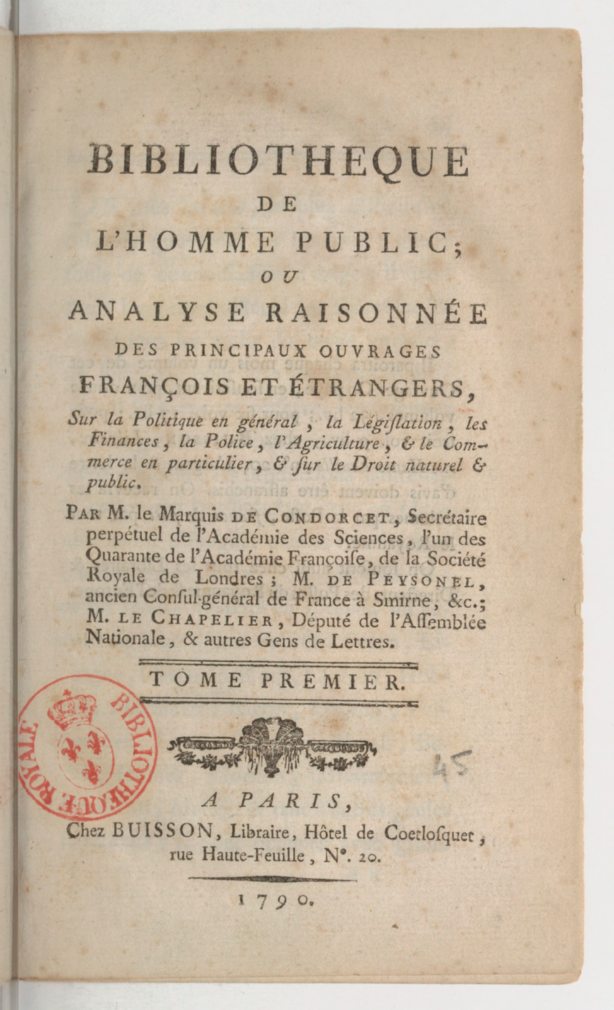
The BHP was published between February 1790 and April 1792 by Condorcet and several others, spanning some 28 tomes.  The full title gives an indication of the nature of the project: Bibliothèque de l'homme public et Analyse raisonnée des principaux ouvrages français et étrangers sur la politique en général, la législation, les finances, la police, l'agriculture et le commerce en particulier, et sur le droit naturel et public.  (BNF Link
It was one of numerous efforts by Condorcet to contribute to public instruction and he published a number of pieces, most notably his Cinq Mémoires sur l'instruction publique (1791) and the discussion of Smith referenced below.  As Tourneux notes, however that his role was not clearly defined: 
 
Barbier l'attribue à l'abbé Balestrier de Canilhac, dont le nom ne figure ni sur les titres, ni dans les avant-propos. Celui de Peyssonnel disparait au tome VI et Condorcet est seul nommé à partir du tome XI. Ce recueil, qui avait pour but de mettre autant que possible la science du gouvernement et de l'administration à la portée de tout le monde.... (Tourneux, Vol 2 p. 648).

While the BHP was aimed the education and raising awareness of newly minted French citizens by publishing the "analysis of well-known works, both ancient and modern.” (Faccarello-Steiner 2002, p. 82), it was not always well received as noted in the Journal des révolutions, 1790, VII, p. 9-10 link):

Bibliothèque de l'homme public, par MM. de Condorcet, Chapelier et Peyssonnel ; le premier n'y travaillera point, le second n'y travaillera guère ; le dernier est vieux et cacochyme, il est froid et lent, deux qualités que n'avaient point Bayle, le Clerc et l'abbé Prévost.

It featured extended discussions and extracts of numerous French, English as well as classical authors, including major figures such as Aristotle, Machiavel, Bodin, Hobbes, Locke, Smith, Montesquieu, and Hume, as well a contemporary figures such as Mirabeau and Raynal and lesser known authors such as Guicciardini.  While generally expository, not all of the discussions were intended to be positive:

La vivacité naturelle à l'esprit françois, l'économie du tems , l'ennui qu'entraîne un long ouvrage sur des matières, aussi sérieuses, le caractère national, tout concourt à nous faire adopter la méthode Analytique. [...]  On fera connoître aussi tous les ouvrages relatifs à ce plan, à mesure qu'ils paroîtront: on se permettra même des réflexions critiques, sans toutefois blesser l'amour-propre des auteurs: la malignité aigrit, & n'éclaire pas mieux qu'elle ne corrige.  (Bib homme public, 1790, vol 1 pp. vi & viii)
Smith's Wealth of Nations, for example, is extensively covered, taking up some 220 pages of the BHP. Diatkine (1993) argues that the summary is "very inaccurate", going on to suggest 
[T]he summary published by Bibliotheque de I'Homme Public is the Wealth of Nations minus the 'Invisible Hand'. This shortcoming is too systematic to be attributed to a casualness of approach or to technical difficulties. We are in the presence paradox: here is a book which seems to be very important, yet completely misunderstood. (pp 219-220)
The (BHP) is a highly intertextual collection with a significant number of direct and indirect references to a large number of major authors as well as relatively minor texts. It reflects a distillation and selection of late Enlightenment views on the nature of government and society.  Reading the BHP in the context of the Intertextual Hub allows one to navigate this collection with an eye to the intellectual inheritance and as well as later influences of the authors and texts had during the Revolution.


There are, of course, a great number of texts in the collects deployed in the Intertextual Hub that have many borrowed, reused, or paraphrased passages that can be identified.  For example, the two volume  Les délassemens d'un homme d'esprit, ou nouveau recueil de pensées amusantes, extraites des meilleurs auteurs (1780) is made up of numerous extracts (link to search) organized by theme or subject, such as chapters on SPECTACLES and JALOUSIE.  

This post will be followed by others which we hope will outline the various search and navigation facilities of the Intertextual Hub with a focus on step itineraries from specific starting points.  

Please do post comments below or email us at artfl@artfl.uchicago.edu.  

References

Diatkine D. (1993), "A French Reading of the Wealth of Nations in 1790". In: Mizuta H., Sugiyama C. (eds) Adam Smith: International Perspectives. Palgrave Macmillan, London.  (DOI)

Faccarello, Gilbert and Steiner, Philippe. 2002. The diffusion of the work of Adam Smith in French Language. In Tribe, Keith (ed.), A Critical Bibliography of Adam Smith, London, Pickering and Chatto, pp. 61-119 (link)

Tourneux, M., Bibliographie de l'histoire de Paris pendant la Révolution française, Paris 1890-1913 (BNF)


Read More

Tracing Revolutionary Discourses

Leave a Comment
In our previous blog post in this series, Modeling Revolutionary Discourse, we outlined the integration of various analytic services and entry points to one of the collections -- the French Revolutionary Collection (FRC) -- we are using as part of ARTFL’s NEH funded Intertextual Bridges project.  This provided three distinct ways to approach the richness of the Newberry Library collection, through PhiloLogic4 search and analysis capabilities, through our new TopoLogic instance, and via a ranked relevance retrieval model.  We demonstrated the utility of different models of access and analysis and ways that combining these results could be used to pose different kinds of questions.  For example, using lists of topic words as the basis of rank relevance search can reveal unexpected relationships between documents and discourses.  

The Intertextual Bridges project is based on building ways to visualize and navigate relationships between disparate sets of collections.  For this project, we have started with seven different collections, representing a wide array of documentary materials concerning the French Revolution.  These include the Newberry FRC, the Archives Parlementaires (AP), the Baudouin Collection of Revolutionary Lawsthe Journaux de Marat, as well as 18th century holdings from the ARTFL Frantext Collection, the Goldsmith-Kress Collection, and French holdings of ECCO.  The collections differ from each other in important ways and require specific search and retrieval schemes to allow for proper handling.  The individual speakers of the AP are searchable as part of particular sessions where as the Newberry does not have such data identified.  Simply doing a single build all of the collections into one database instance would reduce the analytic capabilities to the lowest common denominator.  Collection integration properly requires initial builds reflecting the specifics of each dataset, followed by abstraction to a top level interface.  


The first stage of database integration is development of a top level search and retrieval scheme.  For this preliminary work, each of the target collections we built as a separate PhiloLogic4 instance.  We then used the ARTFL Text Preprocessing Library, to extract metadata and word data from the standard representations generated by PhiloLogic4.  This allows us to use PhiloLogic4 services to support navigation back to the text.  The data extraction program allows the treatment of files as either entire documents or as collections of sub-units depending on the available data markup.  The FRC, for example, does not have internal subdivisions and it is treated as one text element per document.  By contrast, the Revolutionary Laws are tagged with divisions reflecting specific laws and other elements.  The Frantext selections and ECCO selections are typically divided into chapters.  Indexing and accessing text elements significantly improves search and retrieval tasks.  


For the purposes of our prototype, we are using the Python Whoosh indexing and search library. We expect to move to a more scalable ranked-relevance search engine for the final product. We have release an instance of our Whoosh-based search tool at:

     https://artflsrv03.uchicago.edu/mark/hub/multipledb.whoosh.html
The search form allows the user to input a list of terms to find and to limit results to the specific collections and/or to time periods.  Results are ordered by a standard relevancy calculation and we have appended a simple count of authors and titles at the bottom of the report. Note that we have turned links to the full text off at this time, since the underlying PhiloLogic4 instances are on an internal research machine which we expect to be updating in the future.  A full implementation will have full links to the documents and other functions, such as TopoLogic, as outlined in our previous blog post.  


For the query "grain subsistance recolte marche farine quantite pain denree prix bled" the search will return many results, displaying the first 100 (by default) instances, showing the relevance score of the document as well optional snippets as shown on the left.  
The snippets may be omitted from the report, which then generates a list of 

corresponding documents.  The search will retrieve and score subsections of documents, such as chapters or sessions in the same way as entire documents.  On the right one finds the continuation of the query for "grain subsistance...".  Limiting the query to the Revolutionary Laws collection will find specific laws on this subject, such as "Décret sur la police du commerce des grains l'approvisionnement des marchés des armées. Du 7 vendémiaire" of Year IV followed by (again in order of relevance to the query words) Décret qui fixe un maximum du prix des grains, farines et fourrages, et prononce des peines contre l'exportation. [11-9-1793].  

Rank relevance retrieval across multiple collections is a useful way to identify documents and passages of interest.  We are also finding that combining this type of query with word vectors representing Revolutionary topics to be a powerful tool to trace aspects of Revolution discourses to often unexpected sources.  We have included two topic models generated from the 26,000 documents Newberry French Revolution collection.  As described earlier, topic models are unsupervised techniques to identify topics in collections of documents.  Topic models identify the topic mix for every document in a collection and well lists of weighted words that are associated with each topic.  The TopoLogic instance of the 50 topic model can be found on
     https://artflsrv03.uchicago.edu/topic-modeling-browser/frc1787_99/


We have included the top ten words in each topic with a link to the ranked relevance search for that topic across all of the collections.  Clicking on Search will will query the words in this list against the Whoosh database.  The parameters are set to display the top 200 documents or sections from the entire collection.  We have also included the same data for a 100 topic model instance (click here).  No single topic model can properly capture the complexity of Revolutionary discourses.  Comparing the lists of 50 and 100 topics, you will find some are complementary, while others emerge only in the 100 topic model.  

While the static searches (clicking on Search with the set parameters) are useful, we recommend that you examine topics in more detail.  You can block copy the words from any of the topics to the search box and set the parameters as you see fit.  We have included on the search form one example.  This is a query for the words of Topic 4 (in the 50 topic model) "constitution pouvoir droit liberte nation peuple autorite homme principe propriete" in documents published before 1789, using the OR operator, and displaying the top 500 instances (click here to run this search).  This will return a list of documents or sections from pre-Revolutionary sources as shown on the right, led off by a translation of David Ramsay's History of the American Revolution and including the state constitution of Massachusetts. Scrolling down to the list of authors, one finds an interesting list of expected and rather unexpected authors including:


  • Du Buat, M. le comte (Louis-Gabriel), : 21
  • Mirabeau, Victor de Riquetti, marquis de, : 20
  • Holbach, Paul Henri Thiry, baron d', : 15
  • De Lolme, Jean Louis, : 14
  • Helvetius, : 13
  • Chamfort, Sébastien Roch Nicholas, : 11
  • Le Trosne, M. (Guillaume François), : 10
  • Mirabeau, Gabriel-Honoré de Riquetti, comte de, : 9
  • Le Mercier de La Rivière, Pierre-Paul, : 8
  • Bodin, Jean, : 8
  • Hume, David, : 7
  • Brissot de Warville, J.-P. (Jacques-Pierre), : 7
  • Franklin, Benjamin, : 6
  • Condorcet, Jean-Antoine-Nicolas de Caritat, Marquis de, : 6
Taking the words from Topic 43: "religion culte pretre eglise dieu fanatisme morale autel clerge divinite" and restricting the results to the 18th century holdings of ARTFL Frantext reveals the strong showing of Holbach (accounting for seven of the top ten most relevant sections) and Helvétius .  The top titles, recalling the sections are counted individually is also suggestive:


  • Lettres juives : 52
  • De l'homme : de ses facultés intellectuelles et de son éducation : 35
  • Essay sur l'hist. génèrale / Voltaire. : 25
  • Le christianisme dévoilé, ou, Examen des principes et des effets de la religion Chrétienne : 17
  • Dictionnaire philosophique : Comprenant les 118 articles parus sous ce titre du vivant de Voltaire, avec leurs suppléments parus dans les Questions sur l'Encyclopédie. : 15
  • Le comte de Valmont : 12
  • Système de la nature, ou, Des loix du monde physique du monde moral : 12
  • Voyage du jeune anacharsis : 11
  • Histoire critique de Jésus-Christ ou analyse raisonnée des Évangiles : 10
  • De la philosophie de la nature : 10
  • Les helviennes : 10
  • Les Incas, ou, La destruction de l'empire du Pérou : 10
  • La contagion sacrée ou Histoire naturelle de la superstition OU Tableau des effets que les opinions religieuses ont produits sur la terre. Tome I : 9
  • Le compère Mathieu : 8
  • Traité sur la tolérance : 8
Moving this time to the 100 topic model, we can look for traces of topic 80 "convention jugement mort royaute inviolabilite souverainete peine tyran crime depute" in pre-1789 texts. In essence, we are asking whether this topic on the tyrannical nature of the sovereignty of the king, so prevalent in revolutionary discourse, has any echoes in earlier texts. It is interesting to see in the results a mix of theoretical works (such as  Bodin's De la république, or Pufendorf's Droit de la nature et des gens), historical accounts (Raynal's Histoire du parlement d'Angleterre, or Boulainvillier's Etat de la France), or literary sources (Voltaire's Cromwell, or Mercier's L'an deux mille quatre cent quarante), thus providing researchers with a broad and diverse overview of discussions of this topic in the pre-revolutionary period. 

In highlighting the possibility of using word vectors that emerge from topic models of Revolutionary discourses, we might be guilty of teleological readings of these earlier texts.  This one approach is simply to demonstrate the the possibility of combining mixtures of algorithms to propose unexpected texts of potentially related interest.  As we move forward, we will be including topic models of the 18th century collections, to allow tracing of earlier topics into the Revolutionary era.  This is another level of navigation that we believe will help guide researchers through large collections, providing access to smaller segments of text are that more tightly focussed on specific issues and topics.  


-- The ARTFL Team


Read More

Modeling Revolutionary Discourse

Leave a Comment
Modeling Revolutionary Discourse

As part of our lead work on ARTFL’s NEH funded Intertextual Bridges project, we are pleased to release a prototype build of the Newberry Library’s French Revolution Collection (FRC), which integrates topic model browsing and search, relevancy searching, and full PhiloLogic4 services, in a set of interrelated functions. This post will describe the current state of this work, document some of the functionalities, and provide an outline of our next steps of development.

In 2017, the Newberry library released digital copies of more than 35,000 pamphlets totalling approximately 850,000 pages of it’s extremely rich holdings related to the French Revolution. Shortly thereafter, ARTFL project released versions of the Newberry FRC under PhiloLogic4 of this unparalleled resource. In a subsequent post, we described the collection, some of the capabilities of this initial installation and preliminary results using the tools deployed in this build.

We have two builds of the FRC under PhiloLogic. The first is simply a load of the entire collection of 38,377 documents as it was downloaded towards the end of 2017. We applied some error correction functions, which we recently modified slightly applied to the installation (search form). The bulk of our work has been aimed at the FRC collection for works from 1787-1799 with the aim to improve the data and metadata as well as remove duplicate documents. The 2017 release of the FRC at ARTFL contained 26,455 documents, where duplicates were identified by metadata comparison. Using data generated our new sequence alignment package TextPair, which identified both similar passages and possibly duplicated documents, we further reduced the collection to 25,935 documents. 

We currently have three entry points to collection. The basic component which underlies the whole system is PhiloLogic, our corpus query engine which houses the words index, the structure and the metadata of the collection:
          https://artflsrv03.uchicago.edu/philologic4/frc1787-99rev2b/
To facilitate the discovery of documents relevant to search queries, we added on a ranked-relevance engine, called Whoosh, which is built on top of the PhiloLogic index:
          https://artflsrv03.uchicago.edu/mark/frc/frc1787-99.whoosh.html
Finally, as an additional way of exploring the topics and discourses that run through the FRC, we built a topic-modeling browser called TopoLogic, which also leverages the PhiloLogic instance:
          https://artflsrv03.uchicago.edu/topic-modeling-browser/frc1787_99/.
While all three systems have specific capabilities and reporting features and function as discrete units, because they share a single data feed model (built from the PhiloLogic index), they are designed to be interoperable, and hence provide links across one another. It is our belief that there is no all-encompassing algorithmic approach to text analysis, and that topic-modeling provides one view that may be worth exploring, but no more so than other methods.

TopoLogic is the latest entry in our quest to build value-added services on top of the standard PhiloLogic index, and leverage topic-modeling techniques to offer an alternate way of exploring text collections. Topic-modeling, the algorithmic technique which we use for this new navigational tool, is an unsupervised machine learning approach designed to facilitate the exploration of large collections of texts where no topical information is provided. As such, this computational method can be a truly useful way of gaining a sense of the topical structure of a corpus -- i.e. to find out what's in there -- and how words are clustered together to form meaningful discourses.

TopoLogic builds upon the topics and semantic fields generated by the algorithm to provide a web-based navigation system which lets users explore topics and discourses across time, as well as word usage within different contexts. The interaction of the three different schemes allows the user to navigate between alternative ways of considering topics across the collection. The following slides are designed to give some idea of how users may navigate between topics, word searches and other capabilities provided by these different systems.


In our experience, there are a number of caveats to consider when using this algorithmic approach to text analysis. First, while topic-modeling is able to uncover relationships between words and documents without a training corpus (thus its unsupervised nature), it does require a certain number of priors, such as the number of topics to uncover, in order to function. In other words, the user of such method needs to determine (through trial and error) what that user deems to be the more meaningful representation of the corpus. Our experience has shown us that slight changes in the underlying texts (such as adding or removing a couple texts), or in the preprocessing steps (such as removing additional function words), can lead to drastically different results. All in all, we have always taken a very measured approach to our interpretation of topic models, and we strongly discourage against relying upon them as the sole source for text analysis.

The systems complement each other by providing checks on the results of particular functions. For example, in slide X above, we present the top 50 documents for topic 19 as measured by topic weight. In using a rank relevancy search for the top 10 tokens for topic 19, we arrive at a rather different list. The differences are due to the interaction of weighting schemes and relevancy measures. Both are useful approaches, but do, by design, deliver somewhat different results.

It is our pleasure to acknowledge that the Newberry Library has released this extraordinary resource under the Open Data Commons Attribution License, ODC-BY 1.0. We believe that this splendid collection and the Newberry’s release of all of the data will facilitate a generation of ground-breaking work in Revolutionary studies. If you find the collection useful, please do contact the Newberry Library to congratulate them on this wonderful initiative and how their efforts contribute to your research. Clovis & Mark
Read More

TextPAIR: a new high-performance sequence aligner

2 comments
We are happy to announce the release of TextPAIR, a new sequence aligner focused on detecting reuses in large body of texts. In many ways, TextPAIR is a successor to the old TextPAIR and PhiloLine released in 2009. But it also differs in important ways which we will highlight here.

The ARTFL-Project has long worked on intertextuality (see our papers section on the ARTFL site), and finding ways to detect similar passages in running text. Although we found great success with PhiloLine, particularly in the context of the Commonplace Cultures project, we also faced certain limitations which we wanted to address, particularly in the case of our recent project to explore the legacies of the Enlightenment in 19th century print culture.

Higher performance

The first issue that we wanted to address was that of performance. PhiloLine certainly wasn't slow, but it also wasn't designed to run a very large scale datasets, and remains to this day an experimental implementation meant to be replaced by a more optimized version. It served us well during the Commonplace Cultures project, where we ran the aligner against 200,000 texts. But the task also took 3 weeks to run, and needed to be broken up into several batches to run entirely. The results were certainly fruitful (over 40 million shared passages were detected!), but rerunning the task with a different set of parameters was out of the question given the deadline for the completion of the project.

As a result, when we started designing the new generation of our sequence aligner, we decided to focus on performance. We also wanted to leverage the rich Python ecosystem of NLP tools, so we decided that we would write this new package in Python (PhiloLine was written in Perl). After a redesign of the matching algorithm, the initial Python version was able to run about 1.5 to 2 times faster, but with also a much higher RAM usage, about 4-6 times more than PhiloLine. Certainly not a ground-breaking difference... Accelerating the alignment by parallelizing the task was out of the question given the memory cost of using multiprocessing in Python.

While we could have at that point decided to use Cython to gain C speed and parallelize the code, we decided to take a look at Go, a relatively new language developed at Google, which excels at running concurrent tasks, and runs significantly faster than Python. After a proof of concept rewrite in Go showed that we could run an alignment of all ARTFL-Frantext's 3,500 texts in under 4 hours on a single core, a task that took about 10 hours with the Python version,, we decided to go for a pure Go implementation of the core aligner code. While the RAM usage was a bit lower in Go than in Python, it was still somewhat high for our purposes, so we decided to use only 32 bit integers for all integer values (instead of the 64 bit default), effectively halving our memory usage. Our highest potential integer values are in the byte positions of passages within documents, and given that we are unlikely to find a 2,147,483,647 -- the maximum value for 32 bit signed integers -- byte text file anytime soon, there was no risk in switching to 32 bit integers. 

After a number of optimizations to the code, we were able to bring down the runtime of our ARTFL-Frantext alignment to a mere 11 minutes (!!!), leveraging all 16 cores (and 32 threads) of our server. With the Python preprocessing included (which combines various normalization steps and the ngram creation), as well as the database loading and web application building, it took a total of 20 minutes to go from the PhiloLogic parsed output to a full functioning web application capable of search through the 60,000 alignments. As a result of these optimizations, we were able to compete the alignment of our Enlightenment legacies project, which compared 1,300 texts from before the 19th century to 115,000 files from the TGB collection, in about 4 hours, most of which was spent preprocessing and filtering the OCR files from the TGB. We were able to run this alignment multiple times using different parameters in order to obtain the best set of results.

A revamped preprocessing stage

A big aspect of the aligner rewrite was our decision to rely as much as possible on the fledging Python ecosystem for all of our text preprocessing. There are many libraries available for preprocessing, but we decided to leverage Spacy, a well-documented and ever improving NLP library, for part-of-speech tagging and lemmatization. We do plan on using more of its features in the future.

We have also worked on building a virtual modernization pipeline for both English (relying on Martin's Mueller's work on TCP resources) and French (using the work Marine Riguet did on modernizing old forms in ARTFL-Frantext). This is an important feature to have when comparing texts from different periods. The typical example in French would be converting old forms of the imperfect ending in -ois/-oit/-oient to -ais/-ait/-aient. 

As we were working on this code, we realized it would be more useful to break-up this preprocessing step from the TextPAIR code so we could reuse it for other text analysis work. We've therefore created a separate library, called text-preprocessing, which is available on Github, and which we are constantly working to improve separately from the TextPAIR code.

A much improved Web Application

The original PhiloLine had a web application associated with it, and which could be used to search through alignments. But the feature set was restricted to searching shared passages using various metadata filtering options. Following in PhiloLogic4's footsteps, TextPAIR's Web interface has added faceted browsing to aggregate reuses in a way that gives a better overall perspective on the reuses present in the database. We also offer a Time Series view of shared passages to better understand how any given author/work has been reused accross time. And finally, we've worked on getting it integrated into PhiloLogic4 (when alignments were built from PhiloLogic4 output) by providing contextual links that take you straight to a PhiloLogic instance. 

Future work

We are looking to improve the current version of TextPAIR on different fronts:
  • Provide an alternate matching algorithm that can link together more loosely related passages
  • Allow for easier configuration of various components of the aligner and Web Application
  • Include a contextualization feature within TextPAIR (as an alternative to linking to a PhiloLogic instance)
  • Provide visualizations of alignments showing clusters of reuses, as well as of document to document shared passages

Some examples of currently running alignment databases


TextPAIR is fully open-source, and we gladly welcome any comments and/or contributions.


Read More

Evaluating the Practices and Legacy of the Enlightenment on 19th Century Print Culture

Leave a Comment
ARTFL is proud to announce the release of two large-scale sequence alignment databases built within the context of a collaborative project with l'Observatoire de la Vie Littéraire (OBVIL). The goal of this project was to investigate the legacy of the French Enlightenment on 19th century print culture. Thanks to the release by the BNF of the "Très Grand Bibliothèque" (TGB), a collection of 128,000 texts from their digital archive, we attempted to evaluate the presence of Enlightenment discourse within the French 19th century, relying on well-known text-reuse detection techniques. This project represented a natural outgrowth from previous research into sequence alignment in large collections, and resulted in the open-source release of TextPAIR, a high performance sequence aligner capable of comparing hundreds of thousands of documents in a mere 4 or 5 hours.

We used two well-curated datasets from the ARTFL Project holdings to form the test samples to identify Enlightenment discourse. The first are the 1,367 documents that comprise the pre-19th century holdings in ARTFL Frantext. This dataset contains a significant, though by no means complete, sample of major and minor French Enlightenment published works. We decide to retain Frantext’s 17th century holdings as part of this study. Thus, the most frequent authors with more than 10 works in this collection are shown in Table One (see bottom of post). The second sample is the complete text of the Encyclopédie of Diderot and d’Alembert as found in the ARTFL edition of this famous work. As mentioned, the ARTFL Frantext corpus and the Encyclopédie are both curated collections that have been largely corrected of input and other errors as well as being reasonable close transcriptions of the original documents with most later editorial interventions having been removed.

The TGB collection, which was meant to be a representative sample of French 19th century print culture, is comprised 128,441 documents which were digitized using Optical Character Recognition. As expected, the quality of the raw data varies widely depending on a whole range of factors, including age, preservation status and print quality, though it was overall of good quality. On the other hand, the document-level metadata was quite inconsistent, and sometimes incorrect, so our collaborators at the Observatoire de la Vie Littéraire had to perform some extensive preliminary work in order to get the data ready for our alignment experiments. This included a number of authorship attribution issues, as well as normalizing the spelling of each author found in the corpus. Additionally, while the vast majority of the texts in the TGB were published during the 19th century, the collection has a significant number of documents which were originally published before 1800. Most of these documents were reprints of earlier texts in complete or selected works or, less commonly, as individual reprints. We used a series of heuristics based on the metadata provided by the BNF to eliminate duplicates and texts originally published before 1800. We removed 17,063 documents from the TGB sample, with the top authors removed listed in Table Two (see bottom of post). This left 112,907 documents in the TGB sample. There are, of course, some titles that should have been retained in the sample and others that should have been removed, since the criteria for removal was based on fairly simple heuristics, such as removing most titles identified as complete works and looking at author year of birth or death, where available, as another criteria. Given that our goal was to draw a picture of the legacy of the Enlightenment using a representative sample of works published in the 19th century, this was a well worth tradeoff given the potential for many false positive reuses that would have been detected from leaving in texts originally written in previous centuries.

Since the primary task of this project is the identification of reused passages, we used the combined word lists of the Frantext sample and the Encyclopédie as the list of words to index in the TGB for both search and alignment applications. This was done in order to reduce the number of unique words (types) to a manageable level and to ignore all the potential OCR errors using the well attested word list of work from our well-curated texts. It did not have an impact on the alignment tasks since we use exact n-gram matching, so any words not found in the source text word list would not be found in the target text. We retained 193,908 types, amounting to a total of 2.1 billion words (tokens). 

TextPAIR (Pairwise Alignment of Intertextual Relations)
While the ARTFL Project had built text alignment packages in the past, this system was not built for very large-scale comparisons -- 100,000+ document ranges. As such, we wanted to create a new software package that could retain the strengths of PhiloLine while addressing the problem of scalability. Speed and scalability is important since data-mining projects often make progress through multiple runs testing various parameters and settings. Thus it was necessary for us to build a tool that we could rerun multiple times without having to wait for weeks for results to come in, as had been the case with the original implementation of PhiloLine.

The TextPAIR package was written over the course of many months during which the team at the ARTFL Project was in regular contact with the team at OBVIL in order to gather as much feedback as possible during the development phase. Its algorithm is based on the same principle used in PhiloLine, combining an n-gram representation of text with an alignment logic inspired by research in DNA sequencing. The alignment software comes with a web application designed to facilitate the exploration of the text-reuses found during the detection phase. This application includes both a faceted browser and a time series feature.

Detecting identical or similar passages requires a one-to-one document comparison of every text in the dataset. Our new program, called TextPAIR, generates a list of similar passages (based on a set of flexible matching parameters) shared between any two texts. This simple approach allows us to find borrowings and other instances of text reuse, from quotations to uncited passages and paraphrases, over large heterogeneous corpora. ln order for TextPAIR to find shared passages, we apply a number of transformations to the texts. For instance, we remove all stopwords, common function words, and short words which tend to be ubiquitous and, thus, are not reliable markers of textual similarity. We also reduce the number of orthographic variants by normalizing spelling where possible, and eliminate all words that occur only once in the dataset. The remaining words are then grouped into units of n-number of words – or n-grams – where each unit overlaps with the preceding and following group. These n-grams form a representation of the text that privileges word rareness over ubiquity, unlike textual representations that retain every single word.

Only once we have performed these textual transformations can we start comparing documents to one another. Because it is designed to run on many thousands of texts, TextPAIR’s matching algorithm is relatively simple and straightforward. Any more complex alignment algorithm, such as the Smith-Waterman algorithm, would significantly increase processing time. The basic principle of our text aligner is to compare sequences of n-grams between two documents. Whenever TextPAIR finds matching n-grams, a relatively rare occurrence, it continues comparing until it no longer finds sufficient matching n-grams. It then determines whether the number of contiguous matching n-grams is large enough to constitute a meaningful shared passage.

The TextPAIR package was built using cutting-edge technologies. Installed as a Python package, it includes a text preprocessing component written in Python, a sequence aligner written in Go to maximize speed and scalability, and a single-page web application written with the VueJS framework to guarantee maximum interactivity when text alignments are deployed in the browser. The package is available as open-source on Github, with accompanying documentation meant to assist other research groups in installing and running their own text-reuse experiments.


TextPAIR: General Results and Usage overview
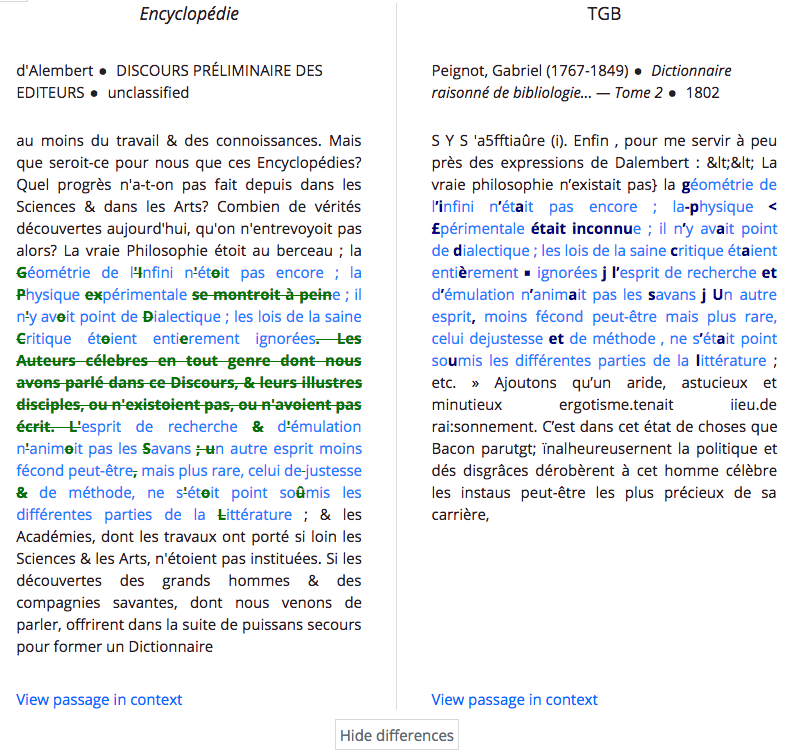
The sequence alignments of the pre 19th century sample of Frantext and the Encyclopédie against the 112,000 documents of the TGB produced a large number of resulting passage pairs, the basic unit of analysis. Figure One shows a typical alignment pair, in this case a passage from the famous Discours Préliminaire reused with some indication of the source in Peignot’s Dictionnaire raisonné de bibliologie. It is important to note that the TextPAIR can detect similar passages with considerable variations which can arise from textual insertions, deletions or modifications along with data capture errors, differences in spellings and word order changes. The figure below uses the “Show differences” feature to highlight the variations between the passage pair.


Each record of the result database stores metadata for each document of the pair from the TEI headers, byte locations and offsets in the corresponding text data files, the passages in question, the size of the alignments, and whether or not the alignment is considered banal. We have in other instances, put addition data describing the passage pair, including whether or not it was from the Bible and related to other passages in the set (commonplace tracking). The databases are loaded into a PostgreSQL relational database with a dedicated interface to allow users to query the document pairs, get summary results and navigate to the original documents at will.

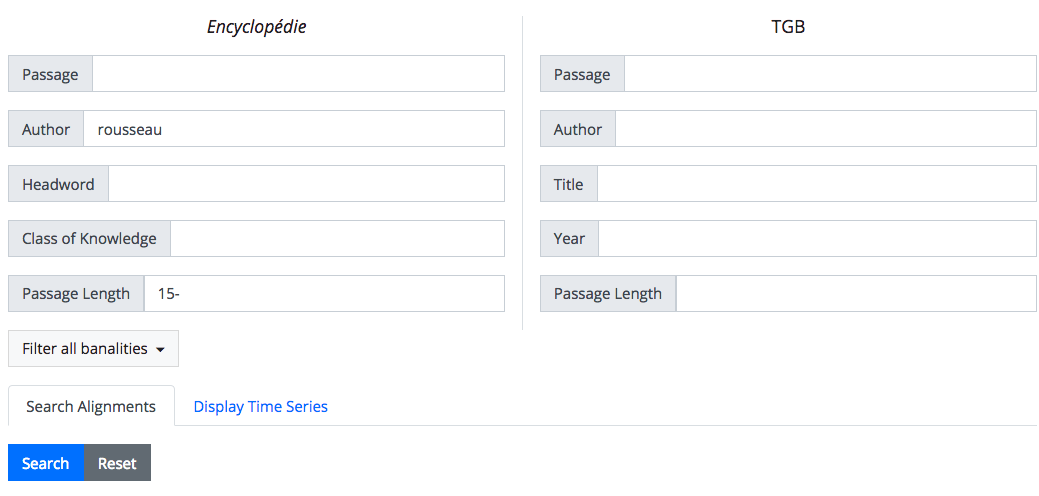
The alignment between the Encyclopédie and the TGB resulted in almost 117,000 records. This number is somewhat deceptive since it contains a number of banal alignments, such as the title of the Encyclopédie and other uninteresting similar passages. Similarly, the alignment between the pre-19th century of ARTFL Frantext and the TGB resulted in just under 295,000 passages, which is reduced to over 201,000 passages when removing short and banal passages. Such filtering is among the many features of the alignment result database implementation. The figure below shows the query form of the Encyclopédie to TGB alignment database, which supports metadata queries to allow the user to focus on specific questions, in this case a search for all aligned passages from articles written by Rousseau.


The query returns 611 passages, as shown in the figure below, where the first reused passage in this query is his article Accolade, which is found pretty much verbatim in a dictionary of music from 1825. 


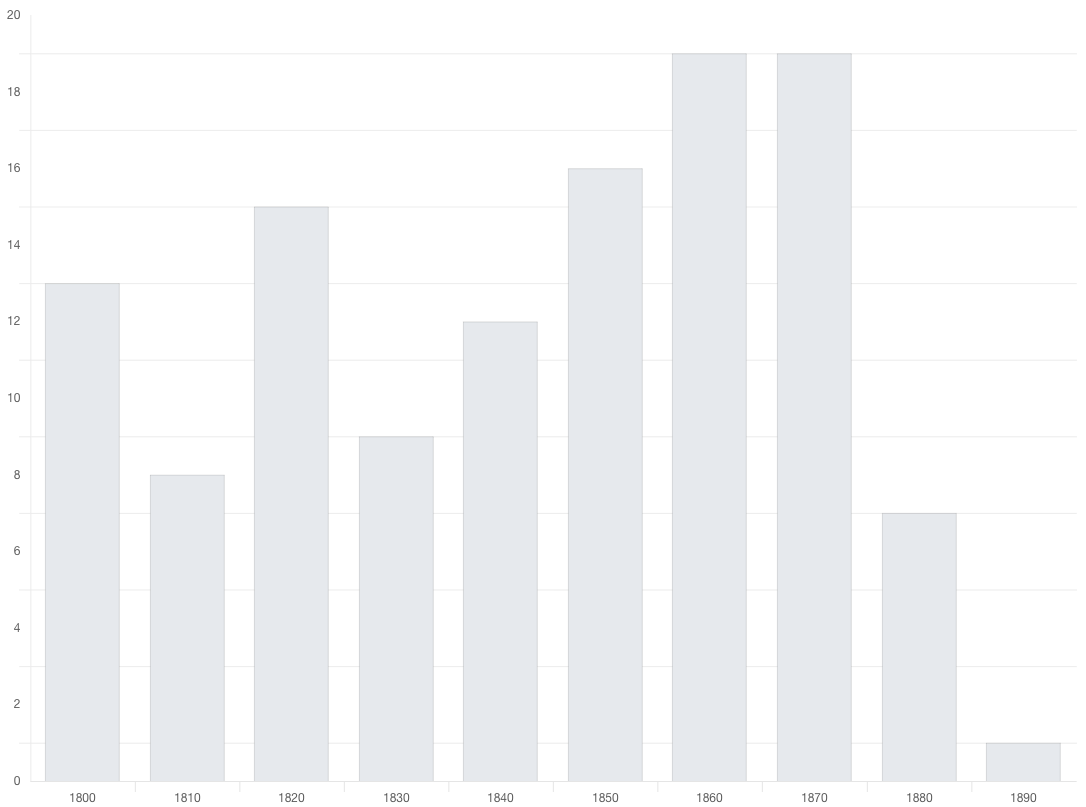
The query interface makes makes extensive use of facets, allowing the user to get frequencies broken down by different criteria. Breaking the reuses of Rousseau’s contributions to the Encyclopédie, it is interesting to note that while most of Rousseau’s entries in the Encyclopédie were about music, it is his political philosophy article “ECONOMIE” that is most reused in the 19th century. The interface supports the generation of time series graphs of the results. Figure Four shows that reuses of the article “ECONOMIE” was fairly consistent through the 19th century.


The Baron d’Holbach is another interesting case. As one of the philosophes with the most notorious reputation as a free-thinking materialists he contributed some of the most controversial articles to the Encyclopédie, such as “Représentants” or “Prêtres”. As shown in the figure on the left, it was his work on chemistry, mineralogy, and German history that is most reused in the 19th century. Instead of his scandalous article on “prêtres” being cited, you get the rather vanilla article “EVEQUE” which outlines the historical background of elector Bishops under the Holy Roman Empire. in fact, not one reuse of d’Holbach’s controversial material was found in the TGB, which sheds new light on our vision of Holbach as not simply an atheist propagandist, but as a man of science whose articles in various domains continued to be cited and used well into the 19th-century. This is an image of d’Holbach that rarely, if ever, occurs in modern intellectual and literary histories.

Algorithms and experiments
We believe that we can begin to use these techniques and these sorts of large-scale databases to refashion literary history, to give a more expansive vision of literary culture, etc.. by identifying various forms of intertextual activity, from reuse to referencing, in a broadened set of 18th-century corpora and to make use of various visualisation tools to navigate the output. In the context of this grant, we decided to concentrate on reuses of the Encyclopédie in the 19th century. While our interpretive work on this set of reuses is still in its initial phases, we have already been able to identify significant findings that change our understanding of the impact of the this great collective work on the 19th century.

We went into this project with the hypothesis that the engin de guerre of the Enlightenment had little to no impact in the 19th century. This was based on the general long-held general opinion on the subject, but it was also backed up by our initial experiments on the ARTFL Frantext corpus of works. However when we moved from this limited corpus to the large-scale TGB corpus, we moved from an exploration of what might be considered as a representative canon of “great works” of the 19th century to what in its vastness might be considered as something coming closer to a representation of a general cultural system.

This change in scale scale led us immediately to note the huge reuse of the Encyclopédie in the genre of dictionaries and encyclopedias published in the nineteenth century. In this area, the Encyclopédie was used as both a model and a source of information. But, more generally, the reuse of the Encyclopédie was more widespread across a broader range of publications than we had expected. So, from this point of view, in spite of the great developments in the sciences in the 19th century, the Encyclopédie remains an important source of information.

On the other hand, the articles that are most often cited in today’s discussions of the Encyclopédie, those heavily ideological articles laying out the aims and goals, those that make us see the Encyclopédie as an engin de guerre for the philosophes, are cited less often than we expected. Thus an author like d’Holbach is rarely reprised in the context of his specifically materialistic articles and more for articles he wrote on mineralogy and chemistry. All of this is to say, that Encyclopédie did have a significant impact in the 19th century, but it was not that which we had expected.

This work is just beginning and we will soon begin to look more closely at the bigger picture – not just the Encyclopédie in the TGB, but all of our various 18th century holdings (including the 18th century texts contained in the TGB corpus itself) – to broaden our understanding of reuse of 18th century in the post-Revolutionary era of the 19th century.


Direct Outcomes of this project
This project resulted in a number of related deliverables. Most importantly is the open source distribution of TextPAIR, as this provides a new model for handling very large scale alignment tasks.
https://github.com/ARTFL-Project/text-pair

The importance of this new software is underlined by the ARTFL Project release of a build of the Newberry French Revolution Collection which includes a open release of an alignment database of ARTFL pre-Revolutionary collection and the more than 26,000 Revolutionary documents. This allows scholar to look directly at the long standing question of the relationship between the Enlightenment and the Revolution.

The second and equally important deliverable from this collaborative work is the publication at ARTFL of both alignment databases as described above. These are complete installations of the alignment databases except that we have disabled links to the full texts of underlying datasets owing to agreements with various collaborators.

Home page of our alignment databases: http://artfl-project.uchicago.edu/legacy_eighteenth

ARTFL Encyclopédie to TGB alignment database: https://artflsrv03.uchicago.edu/text-align/encyc_vs_TGB_0803/

The ARTFL-Frantext to TGB alignment database: https://artflsrv03.uchicago.edu/text-align/frantext_vs_TGB_0803/

=====================================


TABLE One: Frequency of authors (shown with dates) in the Frantext Sample

Voltaire, 1694-1778.                                              85
Diderot, Denis, 1713-1784.                                        45
Corneille, Pierre, 1606-1684.                                     37
Molière, 1622-1673.                                               34
Aulnoy, Madame d'(Marie-Catherine), 1650 or 51-1705.              31
Fontenelle, M. de (Bernard Le Bovier), 1657-1757.                 23
Marivaux, Pierre Carlet de Chamblain de, 1688-1763.               22
Bossuet, Jacques Bénigne, 1627-1704.                              21
Saint-Simon, Louis de Rouvroy, duc de, 1675-1755                  20
Rousseau, Jean-Jacques, 1712-1778.                                17
Mersenne, Marin, 1588-1648.                                       16
Charrière, Isabelle de, 1740-1805.                                14
Fénelon, François de Salignac de La Mothe-, 1651-1715.            13
Montesquieu, Charles de Secondat, baron de, 1689-1755.            13
Prévost, abbé, 1697-1763.                                         13
Racine, Jean, 1639-1699.                                          13
La Fontaine, Jean de, 1621-1695.                                  11
Marot, Clément                                                    11
Balzac, Jean-Louis Guez, seigneur de, 1597-1654.                  10
Du Bellay, Joachim                                                10
Scudéry, M. de (Georges), 1601-1667.                              10


Table Two: Top Authors removed from TGB

Voltaire (1694-1778)                                             249
Molière (1622-1673)                                              243
Racine, Jean (1639-1699)                                         139
Corneille, Pierre (1606-1684)                                    132
La Fontaine, Jean de (1621-1695)                                 129
Chateaubriand, François-René de (1768-1848)                      112
Scott, Walter (1771-1832)                                        105
Boileau, Nicolas (1636-1711)                                     100
Fénelon, François de (1651-1715)                                  96
Scribe, Eugène (1791-1861)                                        84
Rousseau, Jean-Jacques (1712-1778)                                72
Rollin, Charles (1661-1741)                                       69
Diderot, Denis (1713-1784)                                        64
Louis (1755-1824)                                                 63
Florian, Jean-Pierre Claris de (1755-1794)                        60
Marmontel, Jean-François (1723-1799)                              58
Prévost, Antoine François (1697-1763)                             57
Sévigné, Marie de Rabutin-Chantal (1626-1696)                     56
Bachaumont, Louis Petit de (1690-1771)                            55
Cicéron (0106-0043 av. J.-C.)                                     55
Read More
Next PostNewer Posts Previous PostOlder Posts Home